Showing posts with label Constitution. Show all posts

Saturday, October 3, 2009

What is Our Bill of Rights?

We had another constitutional milestone to commemorate this September.

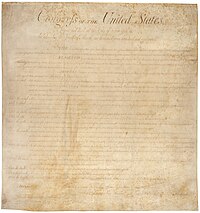
On September 25, 1789, the 1st U.S. Congress sent twelve constitutional amendments to the states for ratification. This was completed on December 15, 1791. The first ten became our Bill of Rights. The United States had become a nation.

Many outspoken proponents of U.S. independence from Great Britain were fervent anti-Federalists. Patrick Henry was a strong opponent. Good Lord, we had just fought a long and bitter war to secure our independence, and now we should turn around and become again subjects of a powerful central Federal government? We had our Articles of Confederation between the states; people were doing fine. A Federal government would only diminish the power of the states; maybe eventually make them disappear altogether.

However, the formation of a Bill of Rights was supported by many anti-Federalists, including John Hancock. They saw that a recitation of citizens’ rights would serve as a powerful antidote against any central government’s attempt to usurp states’ authority. A Bill of Rights would be our protection against large, corrupt government.

I feel that maybe a lot of deals were struck in state legislatures during the ratification process. The Federalists felt that a Bill of Rights would vastly improve citizens’ confidence in a new government: it didn’t have carte blanche to do whatever it wanted.

Yesterday, I heard the expression “Bill of Rights” on a radio news show. It really caught my ear! If you think about it, we don’t hear the expression all that often. The fact that the first ten amendments are our Bill of Rights may not be recognized all that often either. Also, these amendments are referred to by number, such as the 1st, freedom of speech, the 2nd, right to own weapons, etc.

What concepts do these amendments predominantly contain?
1. No restriction by Congress on free speech, religion, the press, the right to assemble.
2. The right to own weapons.
3. Military can’t be billeted in peoples’ homes, without permission. This was very pertinent at the time of our revolution.
4. No unreasonable search and seizure. This amendment has received a lot of attention because of car searches.
5. No accusation for a crime without a formal indictment. Due process. No double jeopardy. No taking of private property for public use without just compensation. The latter has received a lot of attention. The emphasis is on just.
6. A speedy and public trial. To see witnesses. Counsel for defense. Right to counsel was treated quite casually until the Gideon decision in 1963.
7. Trial by jury.
8. No excessive bail. No cruel or unusual punishment.
9. Certain rights not denied to the people. All the rights not set out by the government.
10. States’ rights.

I have not found the Bill of Rights printed independently from the Constitution in sources I’ve used, except in the classic Miracle at Philadelphia*.

Looking over this list, I’m going to say that the Supreme Court spends a lot of time debating the meaning and limitations of amendments 1, 2, 4, 5, and 10.

All of the amendments have over the years been legally examined, debated, tweaked, and even restricted. It depends on the philosophical make-up of the current court. Many amendments have been added since 1791. Certainly, our 13th amendment outlawing slavery and involuntary servitude would find a place in the Bill of Rights today.

Most of the Bill of Rights is taken more or less for granted by us. This is good, because it shows that the bill is firmly a part of our national structure. A lot of the world doesn’t have a semblance of a Bill of Rights, including no freedom of speech, no free press, no freedom of assembly, no speedy public trial. What a permanent credit to so many individuals at the time of our revolution who saw the Bill of Rights as protection against repressive and corrupt government.

People propose adding new amendments all the time, often for the most partisan of issues. Let’s resist this urge! Amendments should be few and far between. Otherwise, we’ll be forced to double the size of the Supreme Court to figure out what all this new legislation really says. – Renata Breisacher Mulry

Reading:

*Miracle At Philadelphia: The Story of the Constitutional Convention May - September 1787.Catherine Drinker Bowen. An Atlantic Monthly Press Book, 1966. 346 pp.

Gideon's Trumpet

Retained by the People: The "Silent" Ninth Amendment and the Constitutional Rights Americans Don't Know They Have

Thursday, September 17, 2009

Commemorating our Constitution

I wish today was a holiday.

On September 17, 1787, the mostly upper-class, propertied men at the Constitutional Convention had finally come out of their political hiding and were told that the Constitution was complete. It could now go to the states for ratification. It needed nine states to approve this.

The outcome was no sure thing. Federalists and Anti-Federalists were in strong disagreement for the need of a central government at all. Many strong Anti-Federalists believed that the final outcome of the Constitution would be to get rid of the states altogether. Many esteemed patriots, including John Hancock and Patrick Henry, were very much against ratification. There was strong interest in how three larger states would vote.

In Massachusetts, John Hancock, was very outspoken about his lack of support. But ever business-minded, he was a late convert. The possibility of a Federal appointment and a Bill of Rights were two issues important to him. Madison worked constantly to accomplish the latter.

The results in Virginia and New York were very close. Patrick Henry, powerful orator as always, felt that Virginians were doing very well under the Articles of Confederation, and didn’t need a Constitution at all.

The The Federalist Papers were a strong advocate for ratification. But it’s important to realize that ratification was not a public election, although the secrecy of the deliberations was completely changed to a very open process, including an active press.

Our Constitution, in a sense, marks the end of our revolutionary war period. The aim for a separate country free from Great Britain had been realized. Now America had to face new and daunting challenges alone.

Among these was the explosive issue of slavery, which lasted another 78 years! – Renata Breisacher Mulry

Sunday, September 13, 2009

The American Revolution Produces Our First Constitution, the Articles of Confederation

On September 17, we can commemorate our national Constitution, 1787, the one in solid place today, the one that is always being scrutinized, what does it say? That’s what the Supreme Court does.

But less than ten years before, some influential Americans, central government proponents, were looking for a more solid direction for the states, which were going their own way. People weren’t too unhappy about it. After all, they were Virginians or New Yorkers first, or whatever their location, before joining any states’ federation for the common good! And they certainly didn’t want to fund any central government! That was an open invitation to corruption. Look at why they were fighting Great Britain; to be free of that uncontrolled power.

The 2nd Continental Congress began to consider the Articles of Confederation, the “United States of America”, in 1776 – 1777.

It was an attempt to designate what, if any, role could be better handled by the states together. From the beginning, dissension between the central versus anti-central government supporters was intense. Funding for a Confederation was actually non-existent, because the states generally never paid their assessments. The states retained enormous power. Over the long run, the articles would be untenable.

They were not ratified until 1781, over the contentious issue of how new states should be admitted. The 13 articles withered on the vine. Their most ferocious critic was, you guessed it, Alexander Hamilton. His message was, “I told you so!”

He saw, that with their financial structure, they were doomed. After a few years, many of the delegates to the Confederation government showed little interest in the proceedings.

There was nothing democratic about how delegates were selected. Many you could identify as machine politicians. The franchise was restricted to those with power and property. No others need apply. Changing this has been unbelievably slow. Consider that women didn’t get the vote until 1920 and poll taxes weren’t eliminated until 1964!

I believe that war (World War I and Vietnam here) seems to produce great domestic changes.

There is some technical quibbling on whether the Articles are a constitution at all. Well, they sound awfully like a constitution to me! The states are all included; the same articles apply to all of them. They are intended to be perpetual, not change every three months. There are rules on how and when delegates may serve. We have that in our present constitution.

A difference is that the powers retained by the states are far greater, although this issue is not completely resolved today.

The Articles did consider some very important issues though. Their main purpose was to prevent states from individually waging wars, making alliances, running as individual countries. There were questions if states could retain armies and navies. Militias were okay. Did citizens had the right to move unhindered from state to state? Issues such as extradition for criminals were considered. The Confederation was to be the final arbiter of disputes between states and it alone could regulate currency. Today, we take these issues either for granted, or look to our Supreme Court to resolve them.

Since the states still held the “power of the purse” and Alexander Hamilton’s objections were correct, it was time for something new. So in 1787, we wrote our second constitution. It’s the one that’s around today.

Please note: I found very clear and engaging testimony in the following source: Carol Berkin, A Brilliant Solution: Inventing the American Constitution. A Harvest Book, Harcourt, Inc., 2002. – Renata Breisacher Mulry

Thursday, August 20, 2009

Our Constitution, an outstanding achievement of our American Revolution


With a new Supreme Court justice in place, as usual there’s been a lot of discussion about our Constitution.

It is often portrayed as something mysterious whose every word needs explanation. I don’t see it that way at all. The words seem simple, to the point. Of course, today when every social ill looks to the Constitution for remedy, those words have to be stretched very far.

What is the role of our Supreme Court regarding it? Do all our constitutional experts shed new light on the Constitution’s meaning? What does our Constitution really have to decide?

Even with lifetime appointments no one can predict how a justice will vote, or which cases will be hard, or if a new amendment is being loudly promoted.

Many cases submitted for constitutional review are never heard at all. A lot are sent down to lower courts, for further review.

Just four years after the end of our revolutionary war (1783), why did we need a federal government, with its operating manual, a constitution? After all, the states already had their Articles of Confederation, which I will describe as a friendship pact between them. However, some rather amazing developments had occurred. Some states had their own currencies; sometimes duties and fees were extracted from other states when their goods reached borders; obviously the situation could not continue. Worst of all, there was no way to raise revenue for general purposes, such as maintaining an army.

I know that any country without a system of reliable taxation won’t last very long. But when the concept of a Federal Republic was proposed, there was intense suspicion, some of the strongest coming from ardent patriots of the Revolution itself, for instance Patrick Henry. Any federal republic or government would only swallow up the power of the states, and grab all of it for itself. A federal government would soon become corrupt and dictatorial. Of course, the federal versus states conflict persists to this day. It occupies a lot of constitutional experts. You can just imagine what controversy it raised in 1787. After all, a huge war was just fought to liberate the colonies from the power of Great Britain.

In spite of the enormous dissent, a constitutional convention was organized in, where else, Philadelphia. Delegates were very different from the familiar leaders of our revolution. Some of the delegates were professional politicians. Many were not that well-known, or promoted. Many delegates did not even have clear directions from their colonial legislatures. The convention saw the rise of two very prominent post-revolutionaries, Hamilton and Madison. They were the outstanding architects of the Constitution.

There was no call for unanimity. If anything significant came out of this convention, it didn’t need to be ratified by every colony.

The proceedings were to be held in secret. Fear about the interference of the public rabble was one compelling reason.

In spite of strong reasons to justify the need for secrecy, I just can’t really accept it. The feeling that any government “hides” facts is very strong for the average citizen.

The concept of a Federal government got great advertising. From 1787 to 1788, The Federalist Papers by Hamilton and Madison, and to a lesser degree Jay, laid out why a Federal government would benefit the new country enormously.
The fact that the constitutional deliberations had so many problems makes the final results so outstanding. Miracle At Philadelphia, a prominent book on the proceedings, is an accurate description.

Many amendments have refined and expanded the Constitution over the years. There is nothing static about this document. This is its strength and potential weakness. A call for a new amendment crops up quite frequently. Many of these call for Congressional legislation, not the Constitution!

The final constitution was accepted by the convention on September 17, 1787. I don’t understand why this date is virtually ignored, not even noted.

That needs changing. How about a fixed – as is July 4th – holiday? Now that should be a popular idea with the American public! – Renata Breisacher Mulry


Miracle At Philadelphia: The Story of the Constitutional Convention May - September 1787. Catherine Drinker Bowen, an Atlantic Monthly Press Book, 1966.

From the beginning: the French and Indian War from Friends of 1776