Saturday, October 3, 2009

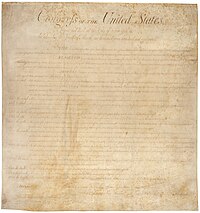
What is Our Bill of Rights?

We had another constitutional milestone to commemorate this September.

On September 25, 1789, the 1st U.S. Congress sent twelve constitutional amendments to the states for ratification. This was completed on December 15, 1791. The first ten became our Bill of Rights. The United States had become a nation.

Many outspoken proponents of U.S. independence from Great Britain were fervent anti-Federalists. Patrick Henry was a strong opponent. Good Lord, we had just fought a long and bitter war to secure our independence, and now we should turn around and become again subjects of a powerful central Federal government? We had our Articles of Confederation between the states; people were doing fine. A Federal government would only diminish the power of the states; maybe eventually make them disappear altogether.

However, the formation of a Bill of Rights was supported by many anti-Federalists, including John Hancock. They saw that a recitation of citizens’ rights would serve as a powerful antidote against any central government’s attempt to usurp states’ authority. A Bill of Rights would be our protection against large, corrupt government.

I feel that maybe a lot of deals were struck in state legislatures during the ratification process. The Federalists felt that a Bill of Rights would vastly improve citizens’ confidence in a new government: it didn’t have carte blanche to do whatever it wanted.

Yesterday, I heard the expression “Bill of Rights” on a radio news show. It really caught my ear! If you think about it, we don’t hear the expression all that often. The fact that the first ten amendments are our Bill of Rights may not be recognized all that often either. Also, these amendments are referred to by number, such as the 1st, freedom of speech, the 2nd, right to own weapons, etc.

What concepts do these amendments predominantly contain?
1. No restriction by Congress on free speech, religion, the press, the right to assemble.
2. The right to own weapons.
3. Military can’t be billeted in peoples’ homes, without permission. This was very pertinent at the time of our revolution.
4. No unreasonable search and seizure. This amendment has received a lot of attention because of car searches.
5. No accusation for a crime without a formal indictment. Due process. No double jeopardy. No taking of private property for public use without just compensation. The latter has received a lot of attention. The emphasis is on just.
6. A speedy and public trial. To see witnesses. Counsel for defense. Right to counsel was treated quite casually until the Gideon decision in 1963.
7. Trial by jury.
8. No excessive bail. No cruel or unusual punishment.
9. Certain rights not denied to the people. All the rights not set out by the government.
10. States’ rights.

I have not found the Bill of Rights printed independently from the Constitution in sources I’ve used, except in the classic Miracle at Philadelphia*.

Looking over this list, I’m going to say that the Supreme Court spends a lot of time debating the meaning and limitations of amendments 1, 2, 4, 5, and 10.

All of the amendments have over the years been legally examined, debated, tweaked, and even restricted. It depends on the philosophical make-up of the current court. Many amendments have been added since 1791. Certainly, our 13th amendment outlawing slavery and involuntary servitude would find a place in the Bill of Rights today.

Most of the Bill of Rights is taken more or less for granted by us. This is good, because it shows that the bill is firmly a part of our national structure. A lot of the world doesn’t have a semblance of a Bill of Rights, including no freedom of speech, no free press, no freedom of assembly, no speedy public trial. What a permanent credit to so many individuals at the time of our revolution who saw the Bill of Rights as protection against repressive and corrupt government.

People propose adding new amendments all the time, often for the most partisan of issues. Let’s resist this urge! Amendments should be few and far between. Otherwise, we’ll be forced to double the size of the Supreme Court to figure out what all this new legislation really says. – Renata Breisacher Mulry

Reading:

*Miracle At Philadelphia: The Story of the Constitutional Convention May - September 1787.Catherine Drinker Bowen. An Atlantic Monthly Press Book, 1966. 346 pp.

Gideon's Trumpet

Retained by the People: The "Silent" Ninth Amendment and the Constitutional Rights Americans Don't Know They Have

Friday, September 25, 2009

The Madness of King George -- Movie Review

The Madness of King George has an outstanding cast, excellent production, beautiful music adapted from Handel. It received the Art Direction Oscar in 1994. I wouldn’t buy it as a gift or even watch it for any type of relaxing entertainment. The theme of this movie is far too intense. I didn’t enjoy watching it, but I’m glad I did. Nigel Hawthorne is outstanding as King George.

George III was the last King of America. Our Declaration of Independence paints a scathing portrait of him, evil, tyrannical, all the reasons for the American Revolution. Much of this is unwarranted.

We weren’t so much anti-monarchy; we just didn’t want George III. In fact, at the constitutional debates, the proposal to have a king was actively discussed.

The subject of this movie is why did George, at the mid-point of his long life (1738 – 1820) begin to exhibit such strange behavior and how did people handle it? It is at times quite a terrifying story.

The movie begins in 1788. The king still refers to America as the “colonies, and his powerful Prime Minister Pitt reminds him that America is now a new country.

George is showing increasing signs of his life-shattering illness. We now believe that the illness was porphyria, which causes irrational speech and bizarre behavior. There are remissions, which George experienced. The disease has never been completely diagnosed in him, although the suspicions are very strong. Symptoms may have been present years before.

It exposed him to the appalling medial treatment of the time. His high rank did not protect him. As his symptoms at times intensified, there was a lot of political talk about establishing a regency with his eldest son, George, indolent, immoral, championed by Fox, a leading political leader strongly disliked by the King. The Prime Minister, Pitt, was against it. King George knew that Fox had a very bad influence on his son.

The medical treatment at times became very harsh, and the movie spares nothing to describe it. George showed great courage against hopeless odds. I feel great sadness for him.

The movie is described as a comic biopic. I couldn’t disagree more. Oh sure, there are amusing comments, but generally the mood is very dark. The genuine affection between George and his wife is very touching. It does not diminish, although the doctors separate them in his illness.

The movie ends of a brighter note. The Kin is in remission, so there is no need for a regency. He waves and basks in the roar of the cheering crowds. His family is with him, even the regent, whom the father heartily despises.

Today, the British monarchy is fully constitutional, which means it doesn’t have a lot to do. It receives visitors, goes on vacations, and sometimes makes goodwill tours. There is also parliamentary protocol which sometimes needs attention.

Above all, the tabloid-featured Royal Family is very good for tourism. – Renata Breisacher Mulry

Media Mania from FriendsOf1776: Sweet Liberty; 1776; The Patriot; Liberty! PBS Series

Save 70% - Now Enjoy Brilliant Courses in Your Car or Home

Free Shipping 125x125

Thursday, September 17, 2009

Commemorating our Constitution

I wish today was a holiday.

On September 17, 1787, the mostly upper-class, propertied men at the Constitutional Convention had finally come out of their political hiding and were told that the Constitution was complete. It could now go to the states for ratification. It needed nine states to approve this.

The outcome was no sure thing. Federalists and Anti-Federalists were in strong disagreement for the need of a central government at all. Many strong Anti-Federalists believed that the final outcome of the Constitution would be to get rid of the states altogether. Many esteemed patriots, including John Hancock and Patrick Henry, were very much against ratification. There was strong interest in how three larger states would vote.

In Massachusetts, John Hancock, was very outspoken about his lack of support. But ever business-minded, he was a late convert. The possibility of a Federal appointment and a Bill of Rights were two issues important to him. Madison worked constantly to accomplish the latter.

The results in Virginia and New York were very close. Patrick Henry, powerful orator as always, felt that Virginians were doing very well under the Articles of Confederation, and didn’t need a Constitution at all.

The The Federalist Papers were a strong advocate for ratification. But it’s important to realize that ratification was not a public election, although the secrecy of the deliberations was completely changed to a very open process, including an active press.

Our Constitution, in a sense, marks the end of our revolutionary war period. The aim for a separate country free from Great Britain had been realized. Now America had to face new and daunting challenges alone.

Among these was the explosive issue of slavery, which lasted another 78 years! – Renata Breisacher Mulry

Sunday, September 13, 2009

The American Revolution Produces Our First Constitution, the Articles of Confederation

On September 17, we can commemorate our national Constitution, 1787, the one in solid place today, the one that is always being scrutinized, what does it say? That’s what the Supreme Court does.

But less than ten years before, some influential Americans, central government proponents, were looking for a more solid direction for the states, which were going their own way. People weren’t too unhappy about it. After all, they were Virginians or New Yorkers first, or whatever their location, before joining any states’ federation for the common good! And they certainly didn’t want to fund any central government! That was an open invitation to corruption. Look at why they were fighting Great Britain; to be free of that uncontrolled power.

The 2nd Continental Congress began to consider the Articles of Confederation, the “United States of America”, in 1776 – 1777.

It was an attempt to designate what, if any, role could be better handled by the states together. From the beginning, dissension between the central versus anti-central government supporters was intense. Funding for a Confederation was actually non-existent, because the states generally never paid their assessments. The states retained enormous power. Over the long run, the articles would be untenable.

They were not ratified until 1781, over the contentious issue of how new states should be admitted. The 13 articles withered on the vine. Their most ferocious critic was, you guessed it, Alexander Hamilton. His message was, “I told you so!”

He saw, that with their financial structure, they were doomed. After a few years, many of the delegates to the Confederation government showed little interest in the proceedings.

There was nothing democratic about how delegates were selected. Many you could identify as machine politicians. The franchise was restricted to those with power and property. No others need apply. Changing this has been unbelievably slow. Consider that women didn’t get the vote until 1920 and poll taxes weren’t eliminated until 1964!

I believe that war (World War I and Vietnam here) seems to produce great domestic changes.

There is some technical quibbling on whether the Articles are a constitution at all. Well, they sound awfully like a constitution to me! The states are all included; the same articles apply to all of them. They are intended to be perpetual, not change every three months. There are rules on how and when delegates may serve. We have that in our present constitution.

A difference is that the powers retained by the states are far greater, although this issue is not completely resolved today.

The Articles did consider some very important issues though. Their main purpose was to prevent states from individually waging wars, making alliances, running as individual countries. There were questions if states could retain armies and navies. Militias were okay. Did citizens had the right to move unhindered from state to state? Issues such as extradition for criminals were considered. The Confederation was to be the final arbiter of disputes between states and it alone could regulate currency. Today, we take these issues either for granted, or look to our Supreme Court to resolve them.

Since the states still held the “power of the purse” and Alexander Hamilton’s objections were correct, it was time for something new. So in 1787, we wrote our second constitution. It’s the one that’s around today.

Please note: I found very clear and engaging testimony in the following source: Carol Berkin, A Brilliant Solution: Inventing the American Constitution. A Harvest Book, Harcourt, Inc., 2002. – Renata Breisacher Mulry

Tuesday, September 8, 2009

Causes of the American Revolution: Part 6 – more on Boston, the Boston Massacre

Massacre is a very ominous word.

Some of history’s most notorious events have this term attached to them. It certainly doesn’t fit what happened in icy Boston on March 1770.

We know relations in Boston and the “British Garrison” had deteriorated rapidly since 1768, when British troops were posted in the city after a serious smuggling incident.

Much of Boston’s volatile street rabble had practically declared open warfare on the British soldiers. This rabble was manipulated by radicals (including Sam Adams) to further their agenda. This was basically “get the British out of Boston, Massachusetts and the rest of colonies”.

In March 1770, the situation in Boston came to a head, with predictable results.

A street mob, many after heavy drinking, was itching for a fight. So they harassed a lone sentry, pelting him with snowballs and chunks of ice. Ten British reinforcements were no match for the menacing crowd.

This was a typical schoolyard bully situation. Pick on someone weaker, taunt them, the victim is outnumbered anyway. Then start the attack.

This was a very, very unfair fight. The results came soon enough. Captain Preston, the British commander, no rookie, was very nervous. The situation was out of control.

A British shot was fired, whether by accident or panic, who knows? Then there were a few more shots. Five Bostonians lay dead.

“Massacre” was the roar of the mob. The British had fired without provocation, wantonly. They will pay for their dastardly deed. Of course, radicals had now just the situation they could exploit, which they began immediately.

For me, the real story starts now. Even today, when a dreadful crime has been committed, and the criminal awaits trial, even with our Constitution and legal safeguards, who would want to defend the obviously guilty person? Forget the process, let the trial begin, pass judgment now.

Fortunately, this doesn’t happen. Of course, the quality of the defense can vary widely. A good lawyer can literally make the difference between life and death. The British soldiers got a very lucky break.

They got the best defense, John Adams, with Josiah Quincy. Adams had no love for the street crowd. He was always very suspicious of the opinion and motivation of any mob. That wasn’t law, that was anarchy.

He did feel that anyone should be defended for a criminal charge, certainly the British. After all, it was a long-held principle of justice.

I don’t feel that the verdict of acquittal for all but two of the soldiers is so amazing. The stories of the witnesses fluctuated widely. Even the jurors must have realized evidence must have some validity, not vary from person to person. Can you imagine the grilling the witnesses got from the defense team?

However, the “Massacre” incident’s notoriety did not subside. Other colonies took up the alleged outrage. The familiar story persists to this day.

However, it does show that even if all you face is an expensive speeding ticket, it will probably pay you to hire a good lawyer! – Renata Breisacher Mulry

Causes of the American Revolution: Part 5 – Boston

Sunday, August 30, 2009

George Washington & The Making of the Prefident 1789 by Marvin Kitman

“Summer reading” is a pleasant tradition, along with holiday movies, Easter brunch, and many others I know you enjoy. I’d like to hear about some of them.

The Los Angeles Times carried a list of books President Obama took on his vacation to Martha’s Vineyard. Included are a couple not considered exactly light reading – John Adams by David McCollough and Tom Friedman’s Hot, Flat, and Crowded.

Bookstores often feature crowded tables full of books, many of them classics, considered good candidates for “summer reading”.

Confess now, did you really read all the titles you brought with you? War and Peace doesn’t count!

I am really enjoying Kitman’s The Making of the Prefident 1789: The Unauthorized Campaign Biography. It’s a very funny, very clever, very readable spoof on George Washington. As the Father of our country shall we agree he’s fair game.

What makes a book readable for me? I can open it at any page and find continuity, the book maintains a lively pace, and generally the chapters are short. Kitman’s book is all of the above.

The back cover carries the following description of the book:

In The Making of the President 1789, humorist and self-appointed historian Marvin Kitman satirizes the contemporary “campaign insider” book while making the case that George Washington was not only “First in War, First in Peace” – he was also first among the Founding Fathers in gambling, drinking, and social climbing. And that’s not to mention his weakness for the Founding Girlfriends.

In an irreverent exposé of how the Mount Vernon Machine engineered the first presidential election victory, Kitman sets out to answer the questions: “How is it possible that a man with virtually no military experience becomes a general? He loses more battle than he wins and becomes a war hero? He has absolutely no political opinion in the most sophisticated intellectual period of our history? He has no ambitions, and he wins?”


Washington looked good, married well, that usually means rich. He engaged in wealth-inducing activities such as land speculation. His constant debt was respectable because after all, it was tied to being a large landowner and planter. Above all, he developed the right social graces, cultivating influential people around him.

He was never insignificant.

Even wearing his splendid uniforms was a powerful campaign tactic. His constant professed modesty got him elected unanimously as our first president. Washington had the luck to be in the right place at the right time.

Will I have the chance to read more in these waning days of summer? I have selected Cooperstown Confidential: Heroes, Rogues, and the Inside Story of the Baseball Hall of Fame. I could finish it by the time of the World Series.

We can’t bet on it. But betting always carries with it the element of surprise. – Renata Breisacher Mulry

Tuesday, August 25, 2009

John Paul Jones and His Role in Our American Revolution

Our Founding Fathers excelled in their accomplishments and importance.

Others also contributed a great deal to the outcome of our revolution – men such as Sam Adams, John Hancock, Patrick Henry.

Also among them is John Paul Jones, dubbed “the Father of the American Navy”.

He was born John Paul in Scotland in very modest circumstances. At 13, he was already apprenticed in the British navy. He showed very quickly that he was a brilliant sailor, full of daring and cunning.

John Paul Jones wreaked havoc on British shipping during the Revolutionary War. He didn’t wait for enemy shipping to come to him – he went where it was located in Great Britain and inflicted his damage there. Astute superiors saw his skills and advanced him to larger and larger vessels.

John Paul’s life was often a contradiction. He had intense ambition, craving to impress those with higher rank and above all, background. Benjamin Franklin was his long-time friend. There were times when John Paul Jones was a celebrity with honors from foreign countries, the toast of many in Europe.

Two incidents determined why he came to the colonies in the first place. They occurred in Tobago in the West Indies. An unfortunate murder charge for the death of someone under his command put a price on his head. Jones always claimed it was self-defense. One of his crews threatened mutiny.

John Paul literally fled, leaving everything. Jones was added to his name when he arrived in the colonies, to give him a better chance of escaping the law in Tobago.

Once here, he began to make the rounds of the shipping business. He disclaimed any allegiance to Great Britain and became an ardent patriot. Not too many questions were asked of those who pledged all their effort to our Revolutionary War.

Any of you that have knowledge of ship structure and capability at the end of the 18th century have a real advantage understanding John’s victories, many against much more powerful ships. Vessels were very complicated, requiring detailed knowledge to keep them running in top shape. Jones had all that. Often he would perform needed repairs himself when necessary. On the ships under his command, he was everywhere, always came up with a plan, got top performance from his crews, and never just barked orders from a cabin.

He wanted to make admiral. The greater his success, the more jealousy he created. Some superiors were his dangerous rivals.

Jones’ most celebrated naval battle was with the powerful British HMS Serapis, when his own Bon Homme Richard (named for Franklin’s Poor Richard’s Almanac) sank. It was at this engagement when Jones is reputed to have exclaimed his most famous quote, “I have just begun to fight”. Those words probably explain his naval philosophy and style better than any other.

He wanted fame, and got it. But it didn’t last.

Foreign engagements, such as for Catherine of Russia, were not successful. Other American sailors got the plush assignments. Jones faded from view and seemed forgotten.

We know he was very ambitious. Well, so was George Washington.

I think ambition is probably an intrinsic requisite for anyone striving to attain the top. But Jones and Washington used ambition very differently. Washington was intent on always being where the power brokers were, the social giants, the political leaders. His conduct was a success. He was sought after, admired, made President. Jones’ life took a very different direction. He was most of the time on the high seas, away from the influential people who could advance him. Later in his life, it made him bitter that he was not appreciated as he felt he deserved.

He died at 45 in France, and buried there without any real recognition and fanfare.

It took until the beginning of the 20th century for us to give him the honors he so justly deserved. The Naval Academy at Annapolis established a grave site for him, appropriate for a hero of his magnitude.

Even my minimal knowledge of 18th century shipping does not detract from my interest in Jones’ biography. It would certainly make a splendid movie. – Renata Breisacher Mulry

John Paul Jones from A&E Biography

More personalities from Friendsof1776.com: Thomas Paine | Daniel Boone

John Paul Jones on Amazon.com