Tuesday, October 27, 2009

The Lottery Wars -- Book Review

Gambling can generate big news. Several days ago, Michael Hiltzik (Los Angeles Times, Business, October 19, 2009) wrote about “calling America’s bluff on online gambling”. The Internet may undergo a dramatic change. Barney Frank (D – Massachusetts, which is a very successful lottery state) is pushing legislation to repeal a federal ban on Internet gambling.

If you can’t eradicate, regulate and take a big chunk out of the wages of sin while you’re at it.

Currently, the Internet has many legal issues. There are some elements which many do not consider suitable for the Internet at all. Financially, collection of sales taxes from state to state has never been settled. For moralists and many politicians, it is considered out of sufficient public scrutiny and particularly dangerous for the young. The usual treatment? Prohibition.

Lotteries have always been part of our colonial history. In 1754, Virginia authorized a lottery to fight the French and Indian War. In 1769, George Washington managed a lottery in Williamsburg. During our Revolutionary War, they raised money for fighting. After the war, they helped sustain the new and struggling country.

Lotteries have always been at war with causes, people, and politicians. Alexander Hamilton liked them, so I guess that his support generated strong opposition. In the decades since 1776, lotteries have gone boom or bust. They have been praised or banned. Only recently, since most states now have official lotteries, they have achieved a certain respectability. After all, they support good works, such as education.

Therefore, adding a new book, The Lottery Wars, to the Friends of 1776 library, seems timely and well-worth reading. The title describes the contents as “Long Odds, Fast Money, and the Battle Over an American Institution”. In spite of the millions who consider gambling a sin, it has never stopped.

This book makes for some very interesting reading. It is crammed full of facts including names and dates. It does not really write about gambling wars as a straight historical text. Rather, it focuses on winners and losers, who gambles and how, and the public fascination with those who win. What is that really like?

A great deal of The Lottery Wars focuses on the public side of lotteries, the business, including many pages exclusively on Joan Borucki, appointed California State Lottery chief in 2007. Her chief goal was to improve the whole financial position of the lottery, and therefore generate more revenue for the state, including education. The California lottery had been badly lagging. Better distribution of sales became very necessary. Tickets went into Big Retail. The $20 lottery ticket began to be accepted.

There is talk of privatizing the whole operation. States would get their money, up front, lots of it, but that would be it. Then the owner keeps the profits. There are a lot of financial and ethical issues with this proposal.

The book differentiates well between how official government regards the lottery and the players’ view. With government, you don’t consider sin, but marketing, growth, sales; it’s a business seminar. The player wants to know how much are the tickets, where are they, what are the prizes. A winner comes well-prepared with an attorney, tax accountant, financial advisor, who else knows what.

Groups, often employees, buy tickets together. I like this; there’s better organization and planning this way. More people have a chance to win something. The office football pool is a popular private lottery. You put your money in, if you win, you get everyone’s. I hope there are no expenses.

Do I gamble the state lottery? No, but I do participate in sweepstakes, a private lottery, run by Publishers’ Clearing House. This has gone on for years. There are good prices for popular magazines I sometimes order. Then I’m entered into the sweepstakes. Actually, I don’t have to order anything, just send in the entry. The payouts are quite high. Will I win? Are you kidding? But when I do, I’ve already made big plans on how to spend the money. – Renata Breisacher Mulry


The Lottery Wars: Long Odds, Fast Money, and the Battle Over an American Institution. Matthew Sweeney. Bloomsbury, 2009. 295 pp.

Sunday, October 18, 2009

Gambling in America

Gambling, gaming, cards, lotteries, racing – they were an integral part of daily life during America’s Revolution. Frequenting gaming parlors and taverns was considered pleasant entertainment for aristocratic gentlemen. They were sophisticated and good company. Whatever criticism was out there, the general population cast away its doubts and gambled also.

Washington gambled all his life. He did what well-bred gentlemen did. After all, that’s what he wanted to be.

In the years since, public perception has varied widely. Lotteries, for instance, have achieved a certain respectability because they can help fund civic projects. In 1777 our Founding Fathers realized the value of lotteries to try to fund a war for which they essentially had no steady revenue. Lotteries weren’t a tax, which boosted their approval.

Today, most states run a lottery. The pay-off is good, it’s all legal, and it’s very easy to play. How much revenue for the state is generated is never completely clear to me. Schools are supposed to be large beneficiaries.

America is addicted to gambling, on anything, anytime, everywhere. Ominous facts about its effects on society have never made any difference. During our prohibition years, gambling (and alcohol) just went underground.

Washington’s troops carried their playing cards into battle. In lean times, they gambled who would get something to eat, even acorns. Washington, in a fine show of hypocrisy, was so concerned about rampant gambling in the ranks that he sent out orders to try and curtail the excessive wagering.

Gambling became an established part of US history. The Mississippi river boats plied their trade successfully. In the “Old West” every community had its representative gambling parlor, with entertainment, liquor, and probably ladies of easier virtue. Men, when not chasing outlaws, were playing and quarreling over poker. Today, casinos have become a glittering destination for serious card playing, slots, good food and accommodations, and of course, entertainment.

Alexander Hamilton, our new country’s money man, had practical ideas on how to sell lottery tickets. Make the tickets cheap. Concentrate on big pay-offs. And for state lotteries, sell ticket by their borders to entice neighbors.

Gambling was always part of our earlier culture. It helped found the colony of Virginia. There was always great dissent, as noted previously.

Americans were so fond of playing cards that when the Stamp Act (1765) included a tax on playing cards, it aroused fury. Our Declaration of Independence was declared only eleven years later!

Is it a sin, to use that potent term, ruining the very fabric of our society? Well, consider a front page article in the LA Times 10/16/2009, describing how a 97 year old woman and two sons in their sixties live in a ’73 Suburban on the streets. Among the items on the dash: lottery tickets.

Private lotteries – the raffle – are very prevalent today. Generally, they are smaller, entry is much cheaper, prizes are smaller, well, mostly. You buy a fifty cent raffle ticket, win a dozen prize cupcakes, and everyone is happy You betcha! –Renata Breisacher Mulry

Smuggling and the American Revolution

Monday, October 12, 2009

Revolution -- Movie Review

I am very afraid of revolutions.

They are violent, unpredictable, original rebels often end up as strongmen or dictators. Just consider Castro. Or more recently, the strong man of Chechnya, Kadyrov. Usually the evils of a previous regime are substituted with a situation just as bad or worse.

There are great hordes of refugees; many lives are ruined for ever.

Our Revolution produced a huge contemporary upheaval in France, 1789. That started out to bring freedom to the citizens, but what did they get instead? The Reign of Terror.

I don’t think France ever really recovered. In the next century, it lost part of its mainland, Alsace-Lorraine, to the Germans. Sure it got it back, at the end of World War I, but at a terrible price.

Revolutions in the 20th century involved millions; we still live with the effects of those in Russia and China and many others. Often there is a raging civil war which accompanies them. There are smaller revolutions usually focused on a specific group of people. They are designated as rebellions, insurrections, civil unrests, military coups.

Much closer to home, Mexico was riddled with revolution till practically World War II. A civil unrest in Sri Lanka has just concluded after decades. In Spain, Basque separatists still surface periodically to inflict terrorist damages.

Do Revolutions produce anything of value? Probably, very very little. But usually the average revolutionary follower is pretty desperate. There likely is no way to redress glaring problems and injustice. Consider the case of Russia. The last Tsar likely would have gradually adopted a more constitutional monarchy. Nobody was willing to wait for this. Instead, the rebel leaders promised people the moon, prosperity, a new order, freedom. None of this happened.

Then what is the amazing difference between our revolution and others? Most significantly, ours did not produce a dictator. We finished a war, signed a peace treaty, wrote a permanent constitution and concentrated on domestic affairs. Our issues with George III and Great Britain were over. Today, our former adversary is considered our oldest and strongest ally. Where else do you find that?

Revolutions have produced some memorable books and movies. The classic A Tale of Two Cities captures the danger of the French Revolution. The romantic Dr. Zhivago plays at the height of the horrendous Russian Revolution. The Spanish Civil War is the the background for Hemingway’s tragic For Whom the Bell Tolls. Marlon Brando portrays the Mexican Revolutionary Zapata in Viva Zapata.

The American Revolution has produced countless history books and documentaries, but I don’t find that much entertainment. So I wanted to mention that I just finished watching a rather interesting movie, with an unusual history. It was made originally in 1985, but was not well received at the time. Revolution: Revisited has just been remastered, with narration and a new introduction.

Al Pacino plays the lead, a very reluctant common revolutionary foot soldier. It’s not his fight, he states often; he doesn’t understand the burning issues which have mobilized people into revolt. He is press ganged into service, separated from his young son, who was tricked into joining up for a few shillings.

The American forces are ragged, ill-treated. They have nothing. But their cause is noble and patriotic; at least that’s what the recruiters tell them. I thought the plight of the common soldier was well portrayed.

What Pacino wants is to just find his son. His wife and other children perished with “fever”. He is doubly desperate. His sole support, a boat, has been commandeered from him with a worthless US chit. He doesn’t read, which would help him understand official-looking documents. The movie script is not strong or that logical. Pacino does find his son, and now they can plan to escape the bedlam around them. A fiercely patriotic girl, but from a loyalist family, turns up in a few confusing scenes. Confusion in some movie scripts seems to be a hazard for me. Strong regional accents don’t help.

Pacino is never converted to the revolution’s patriotic cause. Oh sure, the end of the movie expresses some inspiring sentiments, but I found them superfluous.

This is one man’s story. However, the end of this movie has a scene which I thought was good and very accurate. Pacino is shortchanged on his military pay. Worse, the 150 acres of land he has been promised are non-existent. The have been speculated away to help pay for the war. So Pacino, at the end, still has nothing. This scene shows well the classic case of a hapless citizen trying to deal with government bureaucracy. You may root for these citizens with all your might, but you know they don’t stand a ghost of a chance.

The musical score by John Corigliano throughout is good.

There are quite a few crowd scenes which seem amateurish. The extras are not well directed. One encouraging thing, though: I liked this movie a lot better the second time around.

My rating: a B-. – Renata Breisacher Mulry

Follow me on Twitter!

Saturday, October 3, 2009

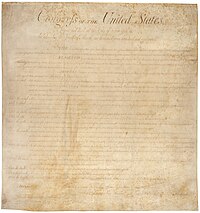
What is Our Bill of Rights?

We had another constitutional milestone to commemorate this September.

On September 25, 1789, the 1st U.S. Congress sent twelve constitutional amendments to the states for ratification. This was completed on December 15, 1791. The first ten became our Bill of Rights. The United States had become a nation.

Many outspoken proponents of U.S. independence from Great Britain were fervent anti-Federalists. Patrick Henry was a strong opponent. Good Lord, we had just fought a long and bitter war to secure our independence, and now we should turn around and become again subjects of a powerful central Federal government? We had our Articles of Confederation between the states; people were doing fine. A Federal government would only diminish the power of the states; maybe eventually make them disappear altogether.

However, the formation of a Bill of Rights was supported by many anti-Federalists, including John Hancock. They saw that a recitation of citizens’ rights would serve as a powerful antidote against any central government’s attempt to usurp states’ authority. A Bill of Rights would be our protection against large, corrupt government.

I feel that maybe a lot of deals were struck in state legislatures during the ratification process. The Federalists felt that a Bill of Rights would vastly improve citizens’ confidence in a new government: it didn’t have carte blanche to do whatever it wanted.

Yesterday, I heard the expression “Bill of Rights” on a radio news show. It really caught my ear! If you think about it, we don’t hear the expression all that often. The fact that the first ten amendments are our Bill of Rights may not be recognized all that often either. Also, these amendments are referred to by number, such as the 1st, freedom of speech, the 2nd, right to own weapons, etc.

What concepts do these amendments predominantly contain?
1. No restriction by Congress on free speech, religion, the press, the right to assemble.
2. The right to own weapons.
3. Military can’t be billeted in peoples’ homes, without permission. This was very pertinent at the time of our revolution.
4. No unreasonable search and seizure. This amendment has received a lot of attention because of car searches.
5. No accusation for a crime without a formal indictment. Due process. No double jeopardy. No taking of private property for public use without just compensation. The latter has received a lot of attention. The emphasis is on just.
6. A speedy and public trial. To see witnesses. Counsel for defense. Right to counsel was treated quite casually until the Gideon decision in 1963.
7. Trial by jury.
8. No excessive bail. No cruel or unusual punishment.
9. Certain rights not denied to the people. All the rights not set out by the government.
10. States’ rights.

I have not found the Bill of Rights printed independently from the Constitution in sources I’ve used, except in the classic Miracle at Philadelphia*.

Looking over this list, I’m going to say that the Supreme Court spends a lot of time debating the meaning and limitations of amendments 1, 2, 4, 5, and 10.

All of the amendments have over the years been legally examined, debated, tweaked, and even restricted. It depends on the philosophical make-up of the current court. Many amendments have been added since 1791. Certainly, our 13th amendment outlawing slavery and involuntary servitude would find a place in the Bill of Rights today.

Most of the Bill of Rights is taken more or less for granted by us. This is good, because it shows that the bill is firmly a part of our national structure. A lot of the world doesn’t have a semblance of a Bill of Rights, including no freedom of speech, no free press, no freedom of assembly, no speedy public trial. What a permanent credit to so many individuals at the time of our revolution who saw the Bill of Rights as protection against repressive and corrupt government.

People propose adding new amendments all the time, often for the most partisan of issues. Let’s resist this urge! Amendments should be few and far between. Otherwise, we’ll be forced to double the size of the Supreme Court to figure out what all this new legislation really says. – Renata Breisacher Mulry

Reading:

*Miracle At Philadelphia: The Story of the Constitutional Convention May - September 1787.Catherine Drinker Bowen. An Atlantic Monthly Press Book, 1966. 346 pp.

Gideon's Trumpet

Retained by the People: The "Silent" Ninth Amendment and the Constitutional Rights Americans Don't Know They Have

Friday, September 25, 2009

The Madness of King George -- Movie Review

The Madness of King George has an outstanding cast, excellent production, beautiful music adapted from Handel. It received the Art Direction Oscar in 1994. I wouldn’t buy it as a gift or even watch it for any type of relaxing entertainment. The theme of this movie is far too intense. I didn’t enjoy watching it, but I’m glad I did. Nigel Hawthorne is outstanding as King George.

George III was the last King of America. Our Declaration of Independence paints a scathing portrait of him, evil, tyrannical, all the reasons for the American Revolution. Much of this is unwarranted.

We weren’t so much anti-monarchy; we just didn’t want George III. In fact, at the constitutional debates, the proposal to have a king was actively discussed.

The subject of this movie is why did George, at the mid-point of his long life (1738 – 1820) begin to exhibit such strange behavior and how did people handle it? It is at times quite a terrifying story.

The movie begins in 1788. The king still refers to America as the “colonies, and his powerful Prime Minister Pitt reminds him that America is now a new country.

George is showing increasing signs of his life-shattering illness. We now believe that the illness was porphyria, which causes irrational speech and bizarre behavior. There are remissions, which George experienced. The disease has never been completely diagnosed in him, although the suspicions are very strong. Symptoms may have been present years before.

It exposed him to the appalling medial treatment of the time. His high rank did not protect him. As his symptoms at times intensified, there was a lot of political talk about establishing a regency with his eldest son, George, indolent, immoral, championed by Fox, a leading political leader strongly disliked by the King. The Prime Minister, Pitt, was against it. King George knew that Fox had a very bad influence on his son.

The medical treatment at times became very harsh, and the movie spares nothing to describe it. George showed great courage against hopeless odds. I feel great sadness for him.

The movie is described as a comic biopic. I couldn’t disagree more. Oh sure, there are amusing comments, but generally the mood is very dark. The genuine affection between George and his wife is very touching. It does not diminish, although the doctors separate them in his illness.

The movie ends of a brighter note. The Kin is in remission, so there is no need for a regency. He waves and basks in the roar of the cheering crowds. His family is with him, even the regent, whom the father heartily despises.

Today, the British monarchy is fully constitutional, which means it doesn’t have a lot to do. It receives visitors, goes on vacations, and sometimes makes goodwill tours. There is also parliamentary protocol which sometimes needs attention.

Above all, the tabloid-featured Royal Family is very good for tourism. – Renata Breisacher Mulry

Media Mania from FriendsOf1776: Sweet Liberty; 1776; The Patriot; Liberty! PBS Series

Save 70% - Now Enjoy Brilliant Courses in Your Car or Home

Free Shipping 125x125

Thursday, September 17, 2009

Commemorating our Constitution

I wish today was a holiday.

On September 17, 1787, the mostly upper-class, propertied men at the Constitutional Convention had finally come out of their political hiding and were told that the Constitution was complete. It could now go to the states for ratification. It needed nine states to approve this.

The outcome was no sure thing. Federalists and Anti-Federalists were in strong disagreement for the need of a central government at all. Many strong Anti-Federalists believed that the final outcome of the Constitution would be to get rid of the states altogether. Many esteemed patriots, including John Hancock and Patrick Henry, were very much against ratification. There was strong interest in how three larger states would vote.

In Massachusetts, John Hancock, was very outspoken about his lack of support. But ever business-minded, he was a late convert. The possibility of a Federal appointment and a Bill of Rights were two issues important to him. Madison worked constantly to accomplish the latter.

The results in Virginia and New York were very close. Patrick Henry, powerful orator as always, felt that Virginians were doing very well under the Articles of Confederation, and didn’t need a Constitution at all.

The The Federalist Papers were a strong advocate for ratification. But it’s important to realize that ratification was not a public election, although the secrecy of the deliberations was completely changed to a very open process, including an active press.

Our Constitution, in a sense, marks the end of our revolutionary war period. The aim for a separate country free from Great Britain had been realized. Now America had to face new and daunting challenges alone.

Among these was the explosive issue of slavery, which lasted another 78 years! – Renata Breisacher Mulry

Sunday, September 13, 2009

The American Revolution Produces Our First Constitution, the Articles of Confederation

On September 17, we can commemorate our national Constitution, 1787, the one in solid place today, the one that is always being scrutinized, what does it say? That’s what the Supreme Court does.

But less than ten years before, some influential Americans, central government proponents, were looking for a more solid direction for the states, which were going their own way. People weren’t too unhappy about it. After all, they were Virginians or New Yorkers first, or whatever their location, before joining any states’ federation for the common good! And they certainly didn’t want to fund any central government! That was an open invitation to corruption. Look at why they were fighting Great Britain; to be free of that uncontrolled power.

The 2nd Continental Congress began to consider the Articles of Confederation, the “United States of America”, in 1776 – 1777.

It was an attempt to designate what, if any, role could be better handled by the states together. From the beginning, dissension between the central versus anti-central government supporters was intense. Funding for a Confederation was actually non-existent, because the states generally never paid their assessments. The states retained enormous power. Over the long run, the articles would be untenable.

They were not ratified until 1781, over the contentious issue of how new states should be admitted. The 13 articles withered on the vine. Their most ferocious critic was, you guessed it, Alexander Hamilton. His message was, “I told you so!”

He saw, that with their financial structure, they were doomed. After a few years, many of the delegates to the Confederation government showed little interest in the proceedings.

There was nothing democratic about how delegates were selected. Many you could identify as machine politicians. The franchise was restricted to those with power and property. No others need apply. Changing this has been unbelievably slow. Consider that women didn’t get the vote until 1920 and poll taxes weren’t eliminated until 1964!

I believe that war (World War I and Vietnam here) seems to produce great domestic changes.

There is some technical quibbling on whether the Articles are a constitution at all. Well, they sound awfully like a constitution to me! The states are all included; the same articles apply to all of them. They are intended to be perpetual, not change every three months. There are rules on how and when delegates may serve. We have that in our present constitution.

A difference is that the powers retained by the states are far greater, although this issue is not completely resolved today.

The Articles did consider some very important issues though. Their main purpose was to prevent states from individually waging wars, making alliances, running as individual countries. There were questions if states could retain armies and navies. Militias were okay. Did citizens had the right to move unhindered from state to state? Issues such as extradition for criminals were considered. The Confederation was to be the final arbiter of disputes between states and it alone could regulate currency. Today, we take these issues either for granted, or look to our Supreme Court to resolve them.

Since the states still held the “power of the purse” and Alexander Hamilton’s objections were correct, it was time for something new. So in 1787, we wrote our second constitution. It’s the one that’s around today.

Please note: I found very clear and engaging testimony in the following source: Carol Berkin, A Brilliant Solution: Inventing the American Constitution. A Harvest Book, Harcourt, Inc., 2002. – Renata Breisacher Mulry